

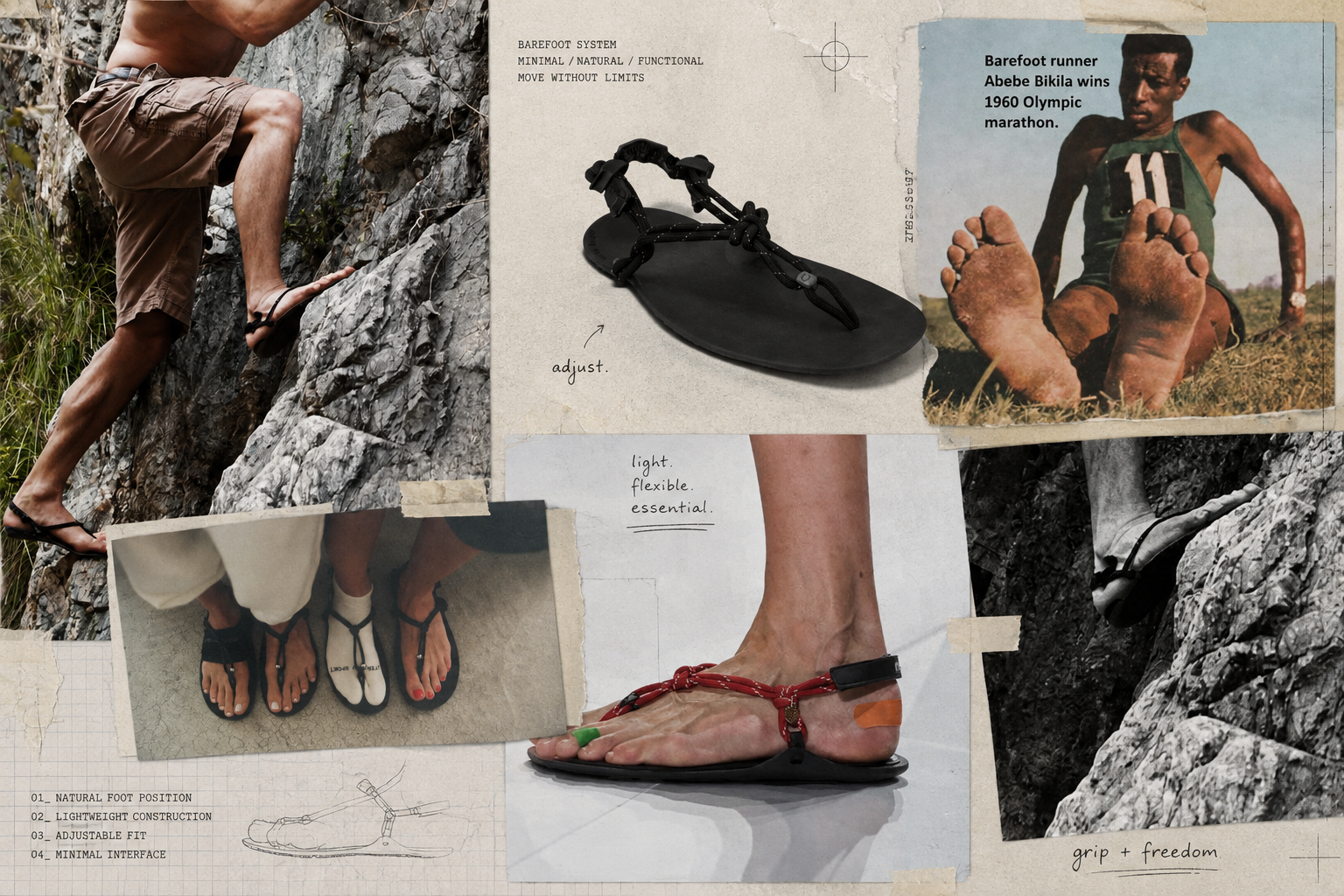
Born from barefoot running, the Xero Genesis is suddenly a fashion object. Its rise suggests something bigger: after years of engineered excess, outdoor design may be getting quieter.
How the Simplest Hiking Sandal Became Fashion's Most Wanted Shoe
For most of the last decade, performance footwear has been moving in one direction: more.
More foam. More stack height. More carbon. More geometry. More visible technology. Trail shoes have become increasingly sculptural objects, their oversized midsoles and complex constructions designed to communicate performance before a foot even touches the ground.
And then there is the Xero Genesis.
A thin piece of rubber. A cord. Almost nothing else.
Originally created from the logic of barefoot running rather than fashion, the Genesis has spent years looking almost aggressively under-designed. Its sole is only around 5.5 millimetres thick. There is no conventional midsole, no elaborate upper, no cushioning system to explain and very little opportunity to hide how the shoe works.
In 2026, that radical simplicity has become precisely what makes it interesting.
Collaborations with J.Crew and Literary Sport have pushed the Genesis from barefoot-running circles and lightweight hiking communities into fashion conversations. A sandal that once looked like the rejection of footwear design suddenly looks remarkably contemporary.
The interesting question isn't simply why fashion discovered a hiking sandal.
It's why it discovered this one.
THE SHOE THAT STARTED AS ALMOST NOTHING
The story begins in 2009 with Xero Shoes co-founder Steven Sashen.
After struggling with recurring running injuries, Sashen began experimenting with barefoot running. Inspired partly by the traditional huarache-style sandals associated with the Rarámuri runners of northern Mexico and by the growing barefoot-running movement surrounding Christopher McDougall's Born to Run, he began making his own minimalist footwear.
The construction was almost primitive in its simplicity: cut a sole from rubber, thread a cord through it and attach it to the foot.
Sashen and Lena Phoenix began selling DIY sandal kits from their home in Boulder, Colorado. The company that would become Xero Shoes grew from there.
The Genesis eventually emerged as a ready-to-wear expression of that original idea. Even as the company expanded into running shoes, hiking shoes and boots, the sandal remained remarkably close to its starting point.
That's important.
The Genesis wasn't designed to look minimal.
It was minimal because the entire philosophy behind it was based on removing things.
Instead of asking what could be added to improve the foot, barefoot footwear asked what could be taken away to allow the foot to function more naturally.
The result was less shoe, not more shoe.
FROM BAREFOOT EXPERIMENT TO FASHION OBJECT
For years, that philosophy existed largely outside mainstream fashion.
Minimal footwear had its own communities: barefoot runners, natural-movement advocates, ultralight hikers and people willing to trade conventional cushioning for ground feel.
Then fashion began moving toward it.
Minimal sandals, toe loops, rope constructions and deliberately exposed feet started appearing throughout luxury footwear. Miu Miu helped push thin cord sandals into the fashion conversation, while designers across the spectrum began exploring increasingly stripped-back silhouettes.
Suddenly the Genesis no longer looked like an eccentric piece of barefoot equipment.
It looked relevant.
The irony is difficult to miss.
Fashion spent years transforming utilitarian outdoor footwear into lifestyle objects. Hiking boots became luxury boots. Trail runners became runway shoes. Technical sandals became fashion staples.
But the Genesis presents a different proposition.
There is almost nothing to reinterpret.
Its construction is already visible. Its materials are obvious. Its identity comes from how little design appears to have been applied to it.
Fashion didn't need to make the Genesis more technical.
It needed to recognise that its lack of excess had become aesthetically powerful.
J.CREW, LITERARY SPORT AND THE SECOND LIFE OF THE GENESIS
That shift became impossible to ignore in 2026.
A collaboration with J.Crew brought the sandal into a broader lifestyle context, but the Literary Sport partnership perhaps reveals more about why the Genesis feels relevant now.
Literary Sport operates in a world where running, books, design and culture overlap. Its version of the Genesis doesn't bury the original sandal beneath a dramatic redesign. Instead, it carefully changes the language of the object.
The familiar cord construction remains immediately recognisable, but leather, silver-toned details and a restrained palette move it into a different visual territory.
The transformation is subtle.
And that's exactly the point.
Instead of turning an outdoor product into a fashion product by adding complexity, the collaboration treats the existing simplicity as something worth preserving.
The original engineering remains legible.
You can look at the sandal and understand almost immediately how it works.
In an era of footwear that increasingly resembles industrial design, that clarity feels surprisingly refreshing.
THE BEAUTY OF VISIBLE CONSTRUCTION
There is another reason the Genesis translates so easily into fashion: honesty.
Nothing is hidden.
The sole is the sole. The cord holds the foot. The knotting and routing of that cord are part of the visual identity because they are also part of the function.
Form and construction become almost impossible to separate.
That quality connects the Genesis to a much broader design movement.
After years dominated by heavily engineered objects, visible functionality is becoming desirable again. People increasingly appreciate products whose construction can be understood rather than merely admired.
The appeal isn't necessarily nostalgia.
It's legibility.
A complicated trail shoe asks you to trust the engineers.
A Genesis sandal shows you everything.
You can understand the entire object in seconds.
And there is something deeply satisfying about that.
THE COUNTERPOINT TO MAXIMAL FOOTWEAR
The timing also matters.
Modern running footwear has entered an extraordinary technological period. Superfoams, carbon plates and extreme stack heights have fundamentally changed what shoes can do.
Those innovations are real.
But every dominant design movement eventually produces its counter-movement.
The Genesis sits almost perfectly at the opposite end of the spectrum.
Where modern performance shoes isolate the foot from the ground, the Genesis emphasises contact.
Where maximal shoes control movement through geometry, minimalist footwear attempts to interfere less.
Where contemporary trail shoes advertise technology through aggressive silhouettes, the Genesis barely has a silhouette at all.
This doesn't make one philosophy objectively better than the other.
It makes the contrast culturally interesting.
After years of asking footwear to do more, some consumers are becoming fascinated by footwear that deliberately does less.
FROM HUARACHE TO HIGH FASHION
There is also a deeper historical layer that shouldn't be lost in the current fashion moment.
The basic architecture behind the Genesis isn't new.
Minimal sandals secured to the foot with simple straps or cords have existed across cultures for centuries. The modern barefoot-running movement drew particular inspiration from the huarache-style footwear associated with Mexico's Rarámuri runners, whose long-distance running culture became internationally famous during the barefoot-running boom of the late 2000s.
What contemporary brands have done is reinterpret an ancient footwear logic through modern materials and manufacturing.
The Genesis replaces traditional materials with a thin synthetic rubber sole and durable cord, but the fundamental idea remains strikingly familiar:
protect the foot only as much as necessary.
That principle now finds itself sitting comfortably beside luxury fashion.
The journey from traditional running sandal to Boulder DIY project to contemporary fashion object is unusual—but perhaps not as contradictory as it first appears.
All three are interested in the same thing.
Reduction.
IS OUTDOOR DESIGN GETTING QUIETER?
This is where the Genesis becomes more interesting than the sandal itself.
Outdoor design has spent years becoming increasingly visible.
Technical features became aesthetic features. Waterproof zippers, bonded seams, ripstop fabrics, trail soles and climbing hardware escaped the mountains and became part of everyday fashion.
Gorpcore turned performance into a visual language.
But once everyone knows that language, its power begins to fade.
The next step may not be even more technical outdoor clothing.
It may be less.
Products that don't need to announce their performance credentials. Objects whose sophistication comes from removing elements rather than adding them. Equipment that feels considered precisely because it isn't visually demanding attention.
The Genesis fits naturally into that shift.
It doesn't look futuristic.
It doesn't look expensive.
It doesn't even look particularly designed.
And perhaps that's exactly why designers and fashion consumers suddenly find it compelling.
The sandal represents something increasingly rare: an object whose identity hasn't been constructed around novelty.
Fashion discovered it almost two decades after the original experiment began.
The product barely needed to change.
THE OUTDOORS AFTER GORPCORE
For years, the relationship between fashion and outdoor culture was easy to identify.
Take something technical and wear it somewhere non-technical.
A shell jacket in Paris. Trail runners in Copenhagen. Climbing pants in London.
The Genesis suggests a more mature phase of that relationship.
Fashion is no longer simply borrowing the visual codes of outdoor performance. It's beginning to engage with the philosophies behind certain pieces of equipment.
Efficiency.
Movement.
Material honesty.
Reduction.
The idea that good equipment doesn't necessarily need to look complicated.
That makes the Genesis culturally more interesting than another hiking shoe becoming fashionable.
Its appeal suggests that people may be developing a different understanding of technical design altogether.
Not technology as spectacle.
Technology as restraint.
ZONTRAC VERDICT
The Xero Genesis didn't become interesting because fashion improved it.
It became interesting because fashion finally caught up with an idea that had been sitting in plain sight for years.
A thin sole. A piece of cord. A foot allowed to move.
After an era defined by increasingly complex performance footwear, the Genesis feels almost radical in its refusal to participate. The collaborations with J.Crew and Literary Sport may have changed its cultural context, but they haven't changed the fundamental reason the sandal works.
There simply isn't much there.
And that might be the point.
If the next chapter of outdoor design is about quieter objects, visible construction and equipment that earns attention through reduction rather than excess, the Genesis isn't following the movement.
It has been waiting for it.